Sunday, January 31, 2010
Those Were The Days
The year 1968 was said to be the year that rocked the world,
culturally and politically. It was also the year we graduated from
NTUMC in Taipei after spending seven years in the school.
We together studied in the classroom and library. We did science
experiments and various projects in the laboratories. We were
young and had a big dream. We also learned how to dance, told
jokes and laughed, took trips, watched movies, and ................... .
Those were the days and we thought they would never end.
In 1968, the final year of school, we completed a one-year internship
program and became doctors. We then said goodbye to each other.
Those were the days, the good old days !
Yeh Tze

Saturday, January 30, 2010
送別 - 夢之旅
This song was adapted from an English song "Dreaming of Home
and Mother" by American song writer J.P. Ordway.
The Chinese title "送別" means "Greeting Farewell".
李叔同《驪歌/送別》
長亭外 古道邊 芳草碧連天
晚風拂柳笛聲殘 夕陽山外山
天之涯 地之角 知交半零落
一壺濁酒盡餘歡 今宵別夢寒
韶光逝 留無計 今日卻分袂
驪歌一曲送別離 相顧卻依依
聚雖好 別雖悲 世事堪玩味
來日後會相予期 去去莫遲疑
Yeh Tze
El Condor Pasa
El Condor Pasa (the Flight of the Condor)
~ Music of Peru
Inca Music (Instrumental)
Yeh Tze
Saturday, January 23, 2010
Three Dimensional Poetry

瀟湘圖 董源(五代南唐畫家)
【沉醉東風 秋景】 盧摯
掛絕壁松梢倒倚,
落殘霞孤鶩齊飛。
四圍不盡山,
一望無窮水。
散西風滿天秋意。
夜靜雲帆影低,
載我在瀟湘畫裡。
This 散曲 by poet 盧摯 of the Yuan dynasty is an example of
“three-dimensional poem”, which has three dimensional views.
First, he applied motion (落殘霞孤鶩齊飛) to a still images (掛絕壁
松梢倒倚 and 四圍不盡山, 一望無窮水)。 He then continued to set
the scene in motion and switched the time from sunset (落殘霞) to
nightfall (夜靜雲帆影低) with another motion image (載我在瀟湘畫裡).
He immersed himself into this picturesque scenery by being floating
in the beautiful 瀟湘 waterways.
As a matter of fact, he did get some help and inspiration from
the ancient poets, 李白 and 王勃, for his poem beginning:
"掛絕壁松梢倒倚,落殘霞孤鶩齊飛。"
李白 【蜀道難】
蜀道之難難於上青天,使人聽此凋朱顏。
連峰去天不盈尺,”枯松倒掛倚絕壁”。
王勃 【滕王閣序】
“落霞與孤鶩齊飛”,秋水共長天一色。
Yeh Tze
Friday, January 22, 2010
Praise Nature

我見青山多嫵媚
Many of us have been led to believe nature is inert or unresponsive.
However, we retain the capacity to see and feel differently if we have
the opportunity and the right quality of mind or spirit. We just need
to use it and have our minds get in tune to the rhythm of nature.
Many of the ancient Chinese poets had done that quite well:
張養浩 【雁兒落帶得勝令--退隱】
雲來山更佳,雲去山如畫,山因海晦明,雲共山高下。
倚仗立雲沙,回首見山家。
野鹿眠山草,山猿戲野花。
雲霞,我愛山無價。
看時,行踏,雲山也愛咱。
李白‧ 【獨坐敬亭山】
眾鳥高飛盡,孤雲獨去閒。
相看兩不厭,只有敬亭山。
辛棄疾
我見青山多嫵媚,料青山見我應如是。
Praise nature and get connected with nature.
Yeh Tze
Wednesday, January 20, 2010
Climate Oscillation and 物極必反

Climate Oscillation
Nature has been repeating the variations in the climate.
Global warming or global cooling?
The climate scientist suggest both trends are oscillations that last
about 30 years in each direction.
El Niño or La Niña ?
El Niño-Southern Oscillation (ENSO) is a quasi periodic climate
pattern that occurs across the tropical Pacific with a roughly 5 year
cycle. It is composed of an oceanic component, called El Niño
(or La Niña), which is characterized by warming or cooling of surface
waters in the tropical eastern Pacific Ocean.
El Niño is Spanish for "the boy" and refers to the Christ child.
"La Niña" is Spanish for "the girl."
Yesterday and today, we, in Northern California, have experienced
the first major thunderstorms for this year with heavy rain, hail,
thunder and lightning. El Niño has been back and is now reaching its
peak, which means we are expecting more heavy rainfall through this
winter season.
Three Australasian researchers have shown that natural forces are
the dominant influence on climate. According to their study, little or
none of the late 20th century global warming and cooling can be
attributed to human activity.
「物極必反」had been mentioned by the ancient Chinese scholar in
周易, and 道家老子 as well, 「物極必反」is a 宇宙自然規律, or what
老子 called the "道". Global warming vs Global cooling, or El Niño vs
La Niña , are all cyclically repeating natural phenomena.
Yeh Tze
Saturday, January 16, 2010
無竹令人俗

題竹圖(蘇軾題竹) 明 檉居杜堇
【題竹】 鄭板橋
一兩三枝竹竿。四五六片竹葉。
自然淡淡疏疏。何必重重疊疊。
【於潛僧綠筠軒】 蘇軾
可使食無肉,不可居無竹。
無肉令人瘦,無竹令人俗。
人瘦尚可肥,俗士不可醫。
傍人笑此言,似高還似痴。
Bamboo painting is an important part of Chinese traditional
painting. Bamboo's long life makes it a Chinese symbol of longevity.
Chinese ancients designated the plum, orchid, bamboo and
chrysanthemum (梅、蘭、竹、菊) as "four gentlemen" (四君子) ;
and pine, bamboo, and plum (竹、松、梅) as the
"three friends in winter" (歲寒三友).
Renowned 唐 poet 白居易, in his ”養竹記”, summed up the merits
of bamboo according to its characteristics:
Its deep root indicates resoluteness (本固), its tall, straight stem
represents reservedness (不倚), its hollow interior denotes
modesty (虛心), and its clean and “Spartan” exterior exemplifies
chastity (剛直). He thus concluded that bamboo lives up to the title
"gentleman" (君子).
白居易《養竹記》
竹似賢,何哉?竹本固,固以樹德,君子見其本,則思善建不拔者。
竹性直,直以立身;君子見其性,則思中立不倚者。
竹心空,空似體道;君子見其心,則思應用虛者。
竹節貞,貞以立志;君子見其節,則思砥礪名行,夷險一致者。
夫如是,故君子人多樹爲庭實焉。..................。
鄭板橋 《詠竹》

咬定青山不放鬆,立根原在破岩中。
幹磨萬擊還堅勁,任爾東西南北風。
司馬遷
竹外有節禮,中直虛空。
世說新語 〔任誕〕
何可一日無此君。
Ancient Chinese literati (文人高士) held bamboo in profound esteem.
This explains why there are so many writings and paintings
dedicated to it throughout history.
Yeh Tze
Monday, January 11, 2010
Bitter Winter 地冷天寒

Bitter Winter 地冷天寒
While Midwestern residents in the United States were gearing up
and preparing for the first winter snow storm of 2010, Europe was
blasted by more snow and Great Britain suffered through its worst
winter snow storm in 40 years.
Over the weekend, bone-chilling snowstorms buffeted northern
China. Snowstorm blanketed Beijing. It was a big freeze there.
Now the world’s most eminent climate scientists say that the bitter
winter afflicting much of the Northern Hemisphere is only the start
of a global trend towards cooler weather that is likely to last for 20
or 30 years, They even predict a “mini ice age”.
When we look at the long-term trend, according to the climate
scientist, trend are oscillations that last about 30 years in each
direction:
1882 - 1910 Cooling
1910 - 1944 Warming
1944 - 1975 Cooling
1975 - 2001 Warming
and therefore
2001 - 2030 Cooling ?
How did the people live through the winter centuries ago?
蘇彥文 of the Yuan dynasty wrote a 【越調】鬥鵪鶉 describing
the tough life during the bitter winter:
【冬景】
地冷天寒,陰風亂刮;歲久冬深,嚴霜遍撒;
夜永更長,寒浸臥榻。
夢不成,愁轉加。
杳杳冥冥,瀟瀟灑灑。
【紫花兒序】
早是我衣服破碎,鋪蓋單薄,凍的我手腳酸麻。
冷彎做一塊,聽鼓打三撾。
天那,幾時捱的雞兒叫更兒盡點兒煞!
曉鐘打罷,巴到天明,劃地波查。
【禿廝兒】
這天晴不得一時半霎,寒凜冽走石飛沙、
陰云黯淡閉日華,布四野.滿長空,無涯。
【聖藥王】
腳又滑,手又麻,亂紛紛瑞雪舞梨花。
情緒雜,囊篋乏。
若老天全不可憐咱,凍欽欽怎行踏?
【紫花兒序】
這雪袁安難臥,蒙正回窯,買臣還家,退之不愛,浩然休誇。
真佳,江上漁翁罷了釣槎。
便休題晚來堪畫,休強呵映雪讀書,且免了這掃雪烹茶。
【尾聲】
最怕的是簷前頭倒把冰錐掛,喜端午愁逢臘八。
巧手匠雪獅兒一千般成,我盼的是泥牛兒四九裏打。
Yeh Tze
Friday, January 8, 2010
老樹 寒鴉
 (layoutsparks.com)
孤村、落日 、殘霞、枯籐 、 老樹、寒鴉 were often mentioned in
poetry of the Yuan Dynasty. Description of the scenery also reflected
the poets’ inner feelings about themselves. In these two comparable
poems, “天淨沙", by 白樸 and 馬致遠, they both had nicely portrayed
the autumn scenes, “秋”. 馬致遠, however, had also incorporated his
思 (thought or emotion) into his "秋" (scenery description).
天淨沙 ‧ 秋 ‧ 白樸
孤村落日殘霞,
輕煙老樹寒鴉,
一點飛鴻影下。
青山綠水,
白草紅葉黃花。
天淨沙 ‧ 秋思 ‧ 馬致遠
枯籐老樹昏鴉,
小橋流水人家,
古道西風瘦馬。
夕陽西下,
斷腸人在天涯。
Yeh Tze
Tuesday, January 5, 2010
Mountain Life
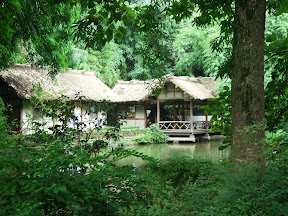
Mountain Life 《數椽茅屋青山下》
雙調•蟾宮曲‧自樂 元 孫周卿
草團標正對山凹,山竹炊粳,山水煮茶。
山芋山薯,山蔥山韭,山果山花。
山溜響,冰敲月牙,掃山雲驚散林鴉。
山色元佳,山景堪誇。山外晴霞,山下人家。
【註】草團標 is 茅舍, the grass house, 山凹 means mountain valley,
粳 is a kind of rice, 山溜 portrays 山泉, 冰敲月牙 depicts icy spring
striking the lake reflection of the new moon.
In this 元曲 by 孫周卿, there is a total of 15 “山”, or “M”(mountain).
It shows that he was totally satisfied with his simple mountain life.
He described his life by starting from his "草團標", then all the things
he enjoyed in the mountain, and finally back to his "山下人家".
山竹, 粳, 山水, 茶, 山芋, 山薯, 山蔥, 山韭, 山果 he found in the
mountain fed his body what it needed, and
山花, 山溜, 月牙, 山雲, 林鴉, 山色, 山景 soothed his soul and
refreshed his spirit.
The mountain life is simple and inspiring. It is a soul-satisfying
experience for 孫周卿.
There were some other “山居自樂”poems by 孫周卿:
水仙子‧山居自樂二首
朝吟暮醉兩相宜,花落花開總不知,虛名嚼破無滋味。
比閒人惹是非,淡家私付與山妻。
水碓裏舂來米,山莊上餞了雞,事事休提。
西風籬菊燦秋花,落日楓林噪晚鴉,數椽茅屋青山下。
是山中宰相家,教兒孫自種桑麻。
親眷至煨香芋,賓朋來煮嫩茶,富貴休誇。
Yeh Tze
Friday, January 1, 2010
May All Your Wishes Be Fulfilled
(By Chinese artist Gao Shan)
May all your wishes be fulfilled
拜年詩 (文徵明)
不求見面准通謁,
名紙朝來滿敝廬。
我亦隨人投數紙,
世間嫌簡不嫌虛。
Many people send greeting cards to convey New Year greetings to
their friends or family members. Besides the common greeting
words, such as “ 吉祥平安” or “萬事如意”, there were often personal
inspirational or cute messages added as well.
New Year's Day is the world's most celebrated holiday. On this day,
many people remember last year's achievements and failures and
look forward to the promise of a new year, of a new beginning.
The New Year poem by 孔尚任 described the New Year Eve's
experience and his New Year feeling:
甲午元旦 (孔尚任)
蕭疏白髮不盈顛,守歲圍爐竟廢眠。
剪燭催乾消夜酒,傾囊分遍買春錢。
聽燒爆竹童心在,看換桃符老興偏。
鼓角梅花添一部,五更歡笑拜新年。
There were however also sorry sentiments, such as:
新年作 (劉長卿)
鄉心新歲切,
天畔獨潸然。
老至居人下,
春歸在客先。
嶺猿同旦暮,
江柳共風煙。
已似長沙傅,
從今又幾年?
“從今又幾年?” is a rather negative, or "無奈" expression.
Of course, it could be also his wishes from the perspective,
and then it is quite positive instead.
Yeh Tze
Subscribe to:
Posts (Atom)